

Molecule of the Month: Natural RNA-Only Assemblies
Large and intricate naturally occurring structures composed exclusively of RNA
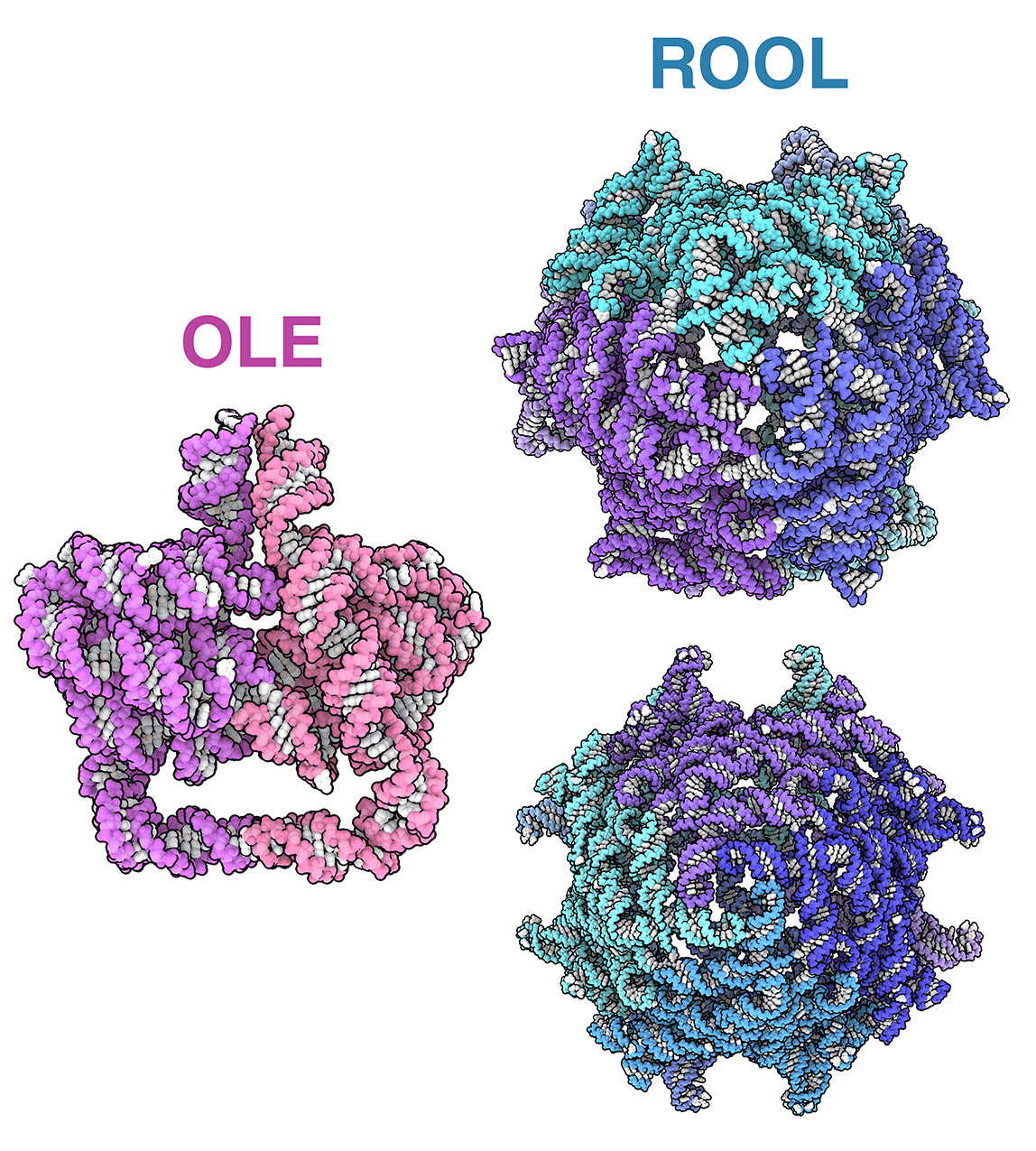
OLE RNA from Clostridium botulinum (pdb_00009lcr) is shown in pink on the left. ROOL RNAs can form cages built from 6 (right, top, pdb_00009j6y) or 8 (right, bottom, pdb_00009mds) subunits.
Download high quality TIFF image
In the central dogma of molecular biology, RNA plays a key role as a messenger between DNA in the nucleus and protein-building machinery in the cytoplasm. In humans, however, only 1-2% of all transcribed RNAs encode for proteins; a majority of RNAs are not translated, or are non-coding. Non-coding RNAs have been found to play key roles in a wide variety of fundamental cellular processes, including transcriptional regulation, splicing, and translation. These RNAs often form complex secondary and tertiary structures that are crucial for their function. For example, ribosomal RNAs, or rRNAs, are long, structured non-coding RNAs that form the enzymatic core of the ribosome. In many cases, such as in the ribosome, RNAs and proteins assemble together to carry out biological tasks.
Intricate RNA Structures
How can new classes of non-coding RNAs with potentially interesting biological functions be identified? Computational biologists have used comparative genomic approaches to discover sequences that are predicted to have significant secondary structure that is conserved across species. Researchers in the Breaker lab at Yale University used this strategy to discover novel non-coding RNA classes in bacterial and bacteriophage genomes. Among the RNAs discovered was a class of unusually large and highly structured RNAs from Gram-positive, extremophilic bacteria. These were named Ornate Large Extremophilic (OLE) RNAs. A similar approach was used to identify ROOL (Rumen-Originating, Ornate, Large) RNAs from bacterial populations inhabiting the stomach of cattle and GOLLD (Giant, Ornate, Lake- and Lactobacillales-Derived) RNAs from bacterial samples collected from Lake Gatun in Panama.
Recently, several structural studies using cryo-EM techniques have shown that these RNAs form intricate, ordered structures. OLE RNAs from Clostridium acetbutylicum (pdb_00009mcw) and Clostridium botulinum (pdb_00009lcr) fold into compact symmetric dimers with two-fold symmetry (shown on the right in pink). The bulk of the structure is made up of a series of double-stranded helices that appear as a tight bundle of rods.
Intriguingly, ROOL and GOLLD RNAs can form hollow, cage-like architectures. While some ROOL RNAs (shown in blue/purple in the illustration on the right) were observed to form primarily octameric cages (pdb_00009mds), other ROOL RNAs formed hexameric complexes (pdb_00009j6y, pdb_00009m78). GOLLD RNA (shown in the figure below, green) was also observed to form a variety of shapes, including a stacked star-like assembly built from 10 RNA subunits (pdb_00009lee), and hollow cages built from 12 (pdb_00009l0r) or 14 RNA subunits (pdb_00009mee).
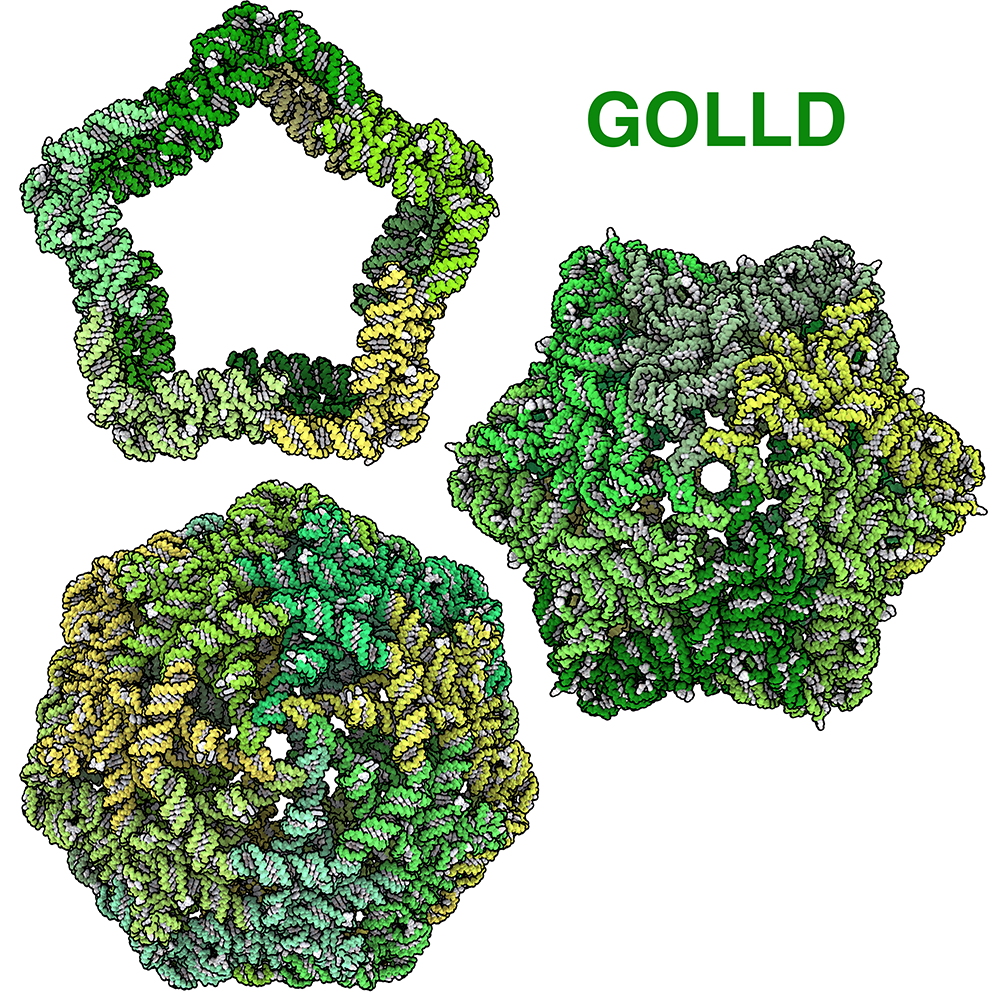
GOLLD RNA complexes have been solved as 10-subunit (top left, pdb_00009lee), 12-subunit (right, pdb_00009l0r), and 14-subunit (bottom left, pdb_00009mee) structures.
Download high quality TIFF image
Hypothesized Functions
The biological significance of these RNA-only architectures is supported by two important lines of evidence. First, although the primary sequence of OLE, ROOL, and GOLLD RNAs varied across different species, researchers noted that there was conservation of intermolecular interfaces and structural motifs. Maintenance of these structures over evolutionary time scales suggests that these RNAs play biologically important functions. Second, stable multimers of RNA formed at physiological concentrations, suggesting that higher order RNA-only structures will readily form within cells.
The precise roles of large, RNA-only structures is currently largely speculative, however. Given the hollow cage-like structures of ROOL and GOLLD complexes, researchers suggest that they may act as structural scaffolds within the cell, helping to sequester or compartmentalize cellular components. OLE RNAs are known to bind to several different protein partners and participate in a variety of processes in extremophilic bacteria, including stress response and metabolic regulation. How OLE and its protein partners carry out these functions, however, remains to be discovered.
Exploring the Structure
A collection of RNA-only structures

Take a closer look at the intricate RNA-only structures formed by OLE (pdb_00009lcr), ROOL (pdb_00009mds), and GOLLD (pdb_00009mee) RNAs.
Topics for Further Discussion
- Learn about self-splicing RNAs.
- Ribosomes and spliceosomes are large complexes with non-coding enzymatic RNAs at their core.
Related PDB-101 Resources
- Browse Nucleic Acids
- Browse Biomolecular Structural Biology
References
- pdb_00009lcr, pdb_00009l0r, pdb_00009j6y: Wang L, Xie J, Gong T, Wu H, Tu Y, Peng X, Shang S, Jia X, Ma H, Zou J, Xu S, Zheng X, Zhang D, Liu Y, Zhang C, Luo Y, Huang Z, Shao B, Ying B, Cheng Y, Guo Y, Lai Y, Huang D, Liu J, Wei Y, Sun S, Zhou X, Su Z. Cryo-EM reveals mechanisms of natural RNA multivalency. Science. 2025 May;388(6746):545-550.
- pdb_00009mds, pdb_00009mee: Kretsch RC, Wu Y, Shabalina SA, Lee H, Nye G, Koonin EV, Gao A, Chiu W, Das R. Naturally ornate RNA-only complexes revealed by cryo-EM. Nature. 2025 Jul;643(8073):1135-1142.
- pdb_00009lee: Zhang S, Yi R, An L, Liu J, Yao X, Li S, Zhang K. Structural insights into higher-order natural RNA-only multimers. Nat Struct Mol Biol. 2025 Oct;32(10):2012-2021.
- Weinberg Z, Perreault J, Meyer MM, Breaker RR. Exceptional structured noncoding RNAs revealed by bacterial metagenome analysis. Nature. 2009 Dec 3;462(7273):656-9.
- Weinberg Z, Lünse CE, Corbino KA, Ames TD, Nelson JW, Roth A, Perkins KR, Sherlock ME, Breaker RR. Detection of 224 candidate structured RNAs by comparative analysis of specific subsets of intergenic regions. Nucleic Acids Res. 2017 Oct 13;45(18):10811-10823.
- Ling X, Golovenko D, Gan J, Ma J, Korostelev AA, Fang W. Cryo-EM structure of a natural RNA nanocage. Nature. 2025 Aug;644(8078):1107-1115. doi: 10.1038/s41586-025-09262-x.
January 2026, Janet Iwasa
http://doi.org/10.2210/rcsb_pdb/mom_2026_1