

January is Cervical Cancer Awareness Month
01/20
January is Cervical Health Awareness Month.
Papillomaviruses are annoying pests that occasionally turn into deadly dangers. They attack cells in our skin and mucous membranes. When they infect cells, they ramp up the normal growth functions, often forming warts. Usually our defenses are able to get the infection under control, but in some exceptional cases, the virus persists and the unwanted growth can turn into cancer. Alarmingly, infection by a few particularly-virulent types of papillomavirus is the leading cause of cervical cancer. Fortunately, by studying these viruses, scientists have discovered highly effective ways to fight them.
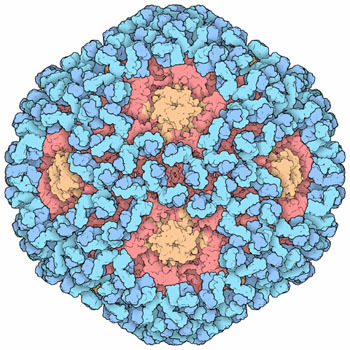 Molecule of the Month: Human Papillomavirus and Vaccines
Papillomavirus is a small virus, with a simple capsid surrounding a circular DNA genome. The includes 360 copies of the major capsid chain, called L1. A second capsid chain, called L2, is found on the inside and may help with packaging the genome. The capsid structure, however, is not a typical quasisymmetrical virus. Instead, like simian virus 40, the L1 chains form 72 pentameric “capsomeres”, which then interact with one another through long flexible tails.
To build a paper model of Papillomavirus, download and print the template PDF. Instructions for cutting and assembling are included.
Use the PDB-101 Browser to explore more resources and articles about viruses.
Past news and events have been reported at the RCSB PDB website and past Newsletters.