Biology of Plants
plant cells build molecular machines for photosynthesis, infrastructure and communication, and protection
Life on the Earth relies on plants: they build sugar from air and water using photosynthesis, and then most living things survive, either directly or indirectly, by consuming them. Plants face unique challenges, since they are usually rooted in place, but still need to find light and nutrients and protect themselves from dangers. Atomic structures have revealed the fine details of the photosynthetic machinery, as well as the many unusual molecules made by plant cells for regulation and protection.
Molecule of the Month Articles (54)
![]() |
Abscisic Acid Receptor
Regulating drought tolerance in plants |
![]() |
Acetohydroxyacid Synthase
In plants, AHAS performs the first step in synthesis of three essential amino acids, making it an effective target for herbicides. |
![]() |
Auxin and TIR1 Ubiquitin Ligase
The plant hormone auxin controls growth and response to light and gravity |
![]() |
Bacteriorhodopsin
Bacteriorhodopsin pumps protons powered by green sunlight |
![]() |
Carbon Capture Mechanisms
Scientists are studying cyanobacteria to improve the productivity of agricultural crops |
![]() |
Carbonic Anhydrase
Carbonic anhydrase solubilizes carbon dioxide gas so we can breathe it out |
![]() |
Carotenoid Oxygenase
Light-sensing retinal molecules are built from colorful carotenoids in our diet |
![]() |
Cellulose Synthase
Plants build tough cellulose strands one sugar at a time. |
![]() |
Concanavalin A and Circular Permutation
For some proteins, clipped and reassembled sequences can produce the same 3D shape |
![]() |
Cytochrome bc1
A flow of electrons powers proton pumps in cellular respiration and photosynthesis |
![]() |
EPSP Synthase and Weedkillers
The weedkiller Roundup attacks a key enzyme involved in the construction of aromatic compounds. |
![]() |
Fatty Acid Synthase
Fatty acids are constructed in many sequential steps by a large protein complex |
![]() |
Green Fluorescent Protein (GFP)
A tiny fluorescent protein from jellyfish has revolutionized cell biology |
![]() |
Isoprene Synthase
Plants release a billion metric tons of isoprene and other organic gases every year. |
![]() |
Monellin
Monellin and other supersweet proteins trick our taste receptors. |
![]() |
Nitrogenase
Nitrogenase uses an exotic cluster of metals to fix atmospheric nitrogen into bioavailable ammonia |
![]() |
Photosynthetic Supercomplexes
Light is captured by huge supercomplexes of photosystems and antenna systems. |
![]() |
Photosystem I
Photosystem I captures the energy in sunlight |
![]() |
Photosystem II
Photosystem II captures the energy from sunlight and uses it to extract electrons from water molecules |
![]() |
Phototropin
Phototrophins sense the level of blue light, allowing plants to respond to changing environmental conditions |
![]() |
Phytohormone Receptor DWARF14
Some phytohormones mobilize the cell’s protein degradation machinery to regulate plant growth and development. |
![]() |
Phytosulfokine Receptor
Phytosulfokine and other small peptides deliver signals about growth and development in plants. |
![]() |
Ricin
The structure of ricin reveals how it kills cells and how vaccines can produce immunity against ricin poisoning |
![]() |
Rubisco
Rubisco fixes atmospheric carbon dioxide into bioavailable sugar molecules |
![]() |
TAL Effectors
TAL-effectors are modular, DNA-reading proteins that can be used to edit DNA in living cells |
![]() |
TOC-TIC Translocon
The large TOC-TIC supercomplex transports proteins into the chloroplast |
![]() |
ZAR1 Resistosome
Plants protect themselves from infection with immune system machines such as the resistosome |

![]() |
Abscisic Acid Receptor
Regulating drought tolerance in plants |
![]() |
Acetohydroxyacid Synthase
In plants, AHAS performs the first step in synthesis of three essential amino acids, making it an effective target for herbicides. |
![]() |
Auxin and TIR1 Ubiquitin Ligase
The plant hormone auxin controls growth and response to light and gravity |
![]() |
Bacteriorhodopsin
Bacteriorhodopsin pumps protons powered by green sunlight |
![]() |
Carbon Capture Mechanisms
Scientists are studying cyanobacteria to improve the productivity of agricultural crops |
![]() |
Carbonic Anhydrase
Carbonic anhydrase solubilizes carbon dioxide gas so we can breathe it out |
![]() |
Carotenoid Oxygenase
Light-sensing retinal molecules are built from colorful carotenoids in our diet |
![]() |
Cellulose Synthase
Plants build tough cellulose strands one sugar at a time. |
![]() |
Concanavalin A and Circular Permutation
For some proteins, clipped and reassembled sequences can produce the same 3D shape |
![]() |
Cytochrome bc1
A flow of electrons powers proton pumps in cellular respiration and photosynthesis |
![]() |
EPSP Synthase and Weedkillers
The weedkiller Roundup attacks a key enzyme involved in the construction of aromatic compounds. |
![]() |
Fatty Acid Synthase
Fatty acids are constructed in many sequential steps by a large protein complex |
![]() |
Green Fluorescent Protein (GFP)
A tiny fluorescent protein from jellyfish has revolutionized cell biology |
![]() |
Isoprene Synthase
Plants release a billion metric tons of isoprene and other organic gases every year. |
![]() |
Monellin
Monellin and other supersweet proteins trick our taste receptors. |
![]() |
Nitrogenase
Nitrogenase uses an exotic cluster of metals to fix atmospheric nitrogen into bioavailable ammonia |
![]() |
Photosynthetic Supercomplexes
Light is captured by huge supercomplexes of photosystems and antenna systems. |
![]() |
Photosystem I
Photosystem I captures the energy in sunlight |
![]() |
Photosystem II
Photosystem II captures the energy from sunlight and uses it to extract electrons from water molecules |
![]() |
Phototropin
Phototrophins sense the level of blue light, allowing plants to respond to changing environmental conditions |
![]() |
Phytohormone Receptor DWARF14
Some phytohormones mobilize the cell’s protein degradation machinery to regulate plant growth and development. |
![]() |
Phytosulfokine Receptor
Phytosulfokine and other small peptides deliver signals about growth and development in plants. |
![]() |
Ricin
The structure of ricin reveals how it kills cells and how vaccines can produce immunity against ricin poisoning |
![]() |
Rubisco
Rubisco fixes atmospheric carbon dioxide into bioavailable sugar molecules |
![]() |
TAL Effectors
TAL-effectors are modular, DNA-reading proteins that can be used to edit DNA in living cells |
![]() |
TOC-TIC Translocon
The large TOC-TIC supercomplex transports proteins into the chloroplast |
![]() |
ZAR1 Resistosome
Plants protect themselves from infection with immune system machines such as the resistosome |

Learning Resources (11)
![]() |
Molecular Machinery: A Tour of the Protein Data Bank
Flyer
The enormous range of molecular shapes and sizes in the PDB archive is illustrated using 96 structures, depicted relative to the cellular membrane.
|
![]() |
Virus Structures
Flyer
Learn about polyhedral, helical, complex, and enveloped viruses with examples drawn at approximately 900,000x magnification. Created in collaboration with EMDataBank.
|
![]() |
Molecular Machinery: A Tour of the Protein Data Bank
Poster
The enormous range of molecular shapes and sizes in the PDB archive is illustrated using 96 structures, depicted relative to the cellular membrane.
|
| Photosynthesis
Video
Plants use photosynthesis to capture energy from sunlight
|
|
![]() |
Interactive Tour of PDB's Molecular Machinery
Viewer
This interactive view of molecular machinery in the PDB archive lets users select a structure, access a 3D view of the entry using the NGL Viewer, read a brief summary of the molecule’s biological role, and access the corresponding PDB entry and Molecule of the Month article.
|
![]() |
Coloring Molecular Machinery
Coloring Book
This is a molecular coloring book for all artists.
|
![]() |
Discovering Biology Through Crystallography
Coloring Book
Color the diverse 3D shapes studied by crystallographers. Created with support from the ACA. Available as a PDF and individual images.
|
| Exploring Carbohydrates
Guide
The RCSB provides many tools to explore the functional roles of carbohydrates.
|
|
![]() |
3D Print: Green Fluorescent Protein
Other Resource
Download curated file of green fluorescent protein (GFP) for 3D printing
|
![]() |
PDB Data, RCSB PDB, and KBase
Other Resource
|
| Exploring the Structural Biology of Bioenergy
Article
Cells capture and utilize many forms of energy to power their molecular processes
|
Structural Biology Highlights (3)
Goodsell Molecular Landscapes (1)
![]() |
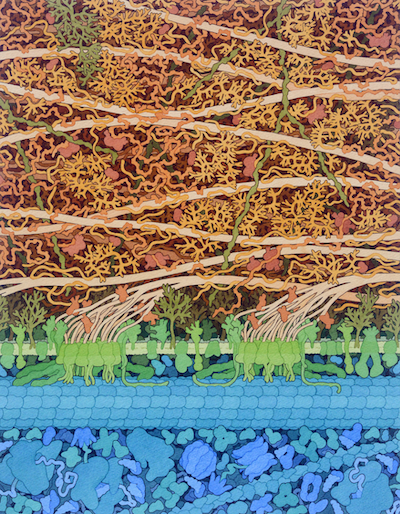
Cellulose Synthase
Cellulose synthase plays a central role in the construction of plant cell walls
|